School certificates: the end of documents taken on trust
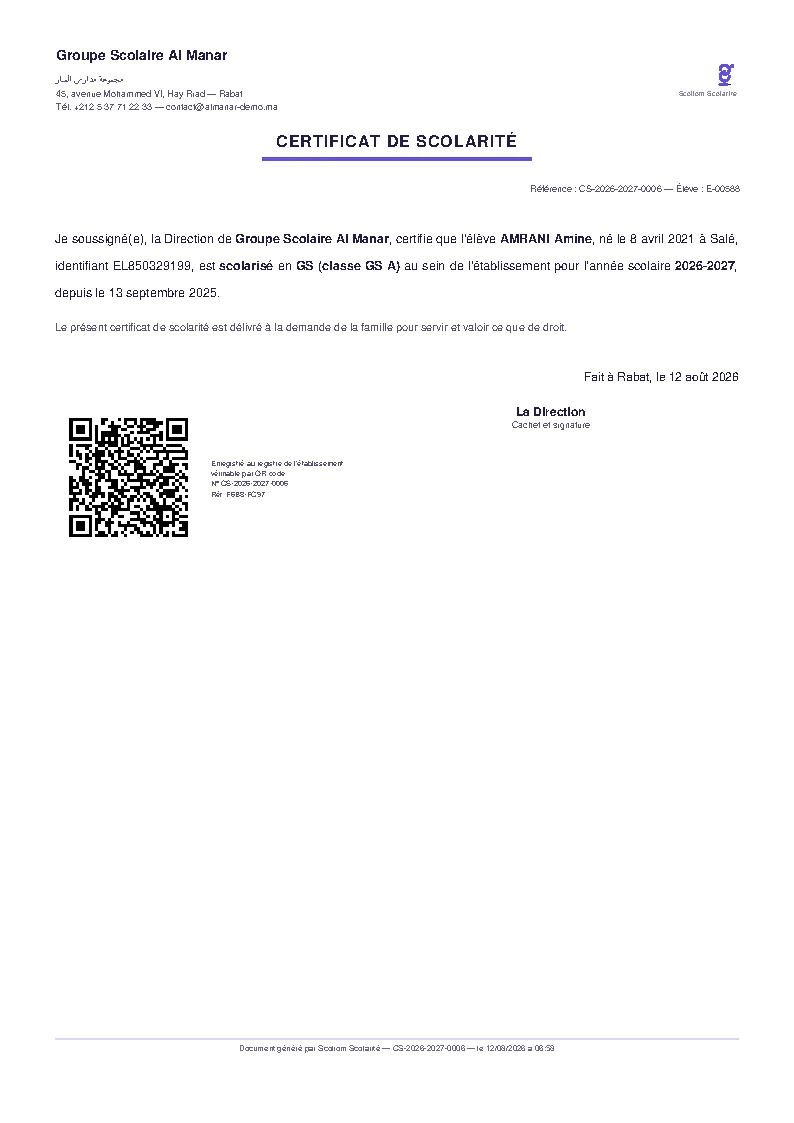
The enrolment certificate is one of the documents most frequently requested from the school office. A family is preparing a visa application. A parent needs to prove to an employer that their child is in school. A pupil leaves the school, and the new school insists on a properly issued exeat. Each time, the routine is the same: the document is produced, signed, stamped and handed over. Then it leaves the building. And the school never sees it again.
That is where the problem begins. A printed certificate can be reproduced in minutes with a word processor. A stamp can be scanned. A signature can be copied. The embassy, the employer or the receiving school has no simple way of telling an original from a careful imitation. So they ring the school office. They write. They ask for confirmation. At best, your team spends time replying. At worst, nobody checks, and a forged document circulates bearing your school's letterhead.
A document worth only the word of whoever presents it
As long as a certificate is nothing more than a signed sheet of paper, its value rests on trust. Whoever receives it has to believe whoever presents it. That trust was enough for a long time, because forgery took genuine effort. This is no longer the case: editing tools are within everyone's reach, and documents increasingly travel as scanned copies, in which the stamp is just one image among others.
The consequences are not theoretical. A forged exeat can open the door to enrolment elsewhere while the file is not in order. A backdated certificate can support an administrative application the school never approved. And with every incident, it is the headteacher's signature that is at stake — on a document they never signed.
The verification QR code: checking changes sides
The principle is simple. Every document issued by the school carries a unique QR code. Whoever receives the document — a consular officer, a human resources department, the office of another school — scans it with a phone. This opens a verification page showing what the school actually issued: the type of document, the pupil's name, the date of issue and its current status.
If the details match, any doubt is settled within seconds. If the code leads nowhere, or if the information displayed differs from the paper presented, the recipient knows exactly where they stand. The document now carries its own proof: it no longer needs your school office to answer the phone in order to be believed.
What this changes in practice
- Fewer back-and-forth exchanges: requests for confirmation by phone or email fall away, because the recipient can check for themselves.
- A register of issued documents: the school knows which certificate was issued, for which pupil, on what date and by whom. If a dispute arises, the record is there.
- A status that follows the document: an exeat that is cancelled or reissued changes status; the old version no longer passes verification.
- A protected signature: a forgery bearing your letterhead does not survive the first scan. The value of your genuine documents is strengthened as a result.
- A refocused school office: the time saved on verification goes back into welcoming families and the work that matters.
Without upending your routines
This change does not require overhauling the school office. Your document templates remain your own: same letterhead, same layout, same signature workflow. The QR code is added at the moment of issue, and the register builds up as requests come in. It can be put in place during the school year, without interrupting the service families rely on: starting from what already exists rather than replacing everything is a principle we hold to.
What remains is to look at your own situation: which documents do you issue, in what volume, and through which signature workflow? That is precisely the purpose of a remote assessment, carried out on your actual documents with your team. The move to verifiable documents is then decided with full knowledge of the facts.
Everything starts with the remote assessment: a 45-minute video call, a written review and a road map — with no commitment.
Request an assessment